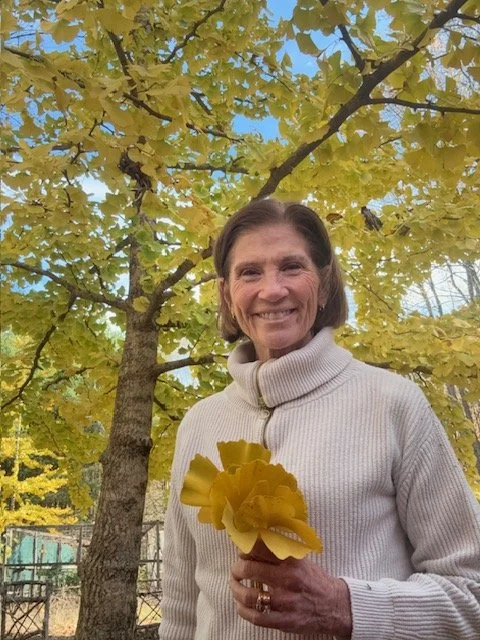
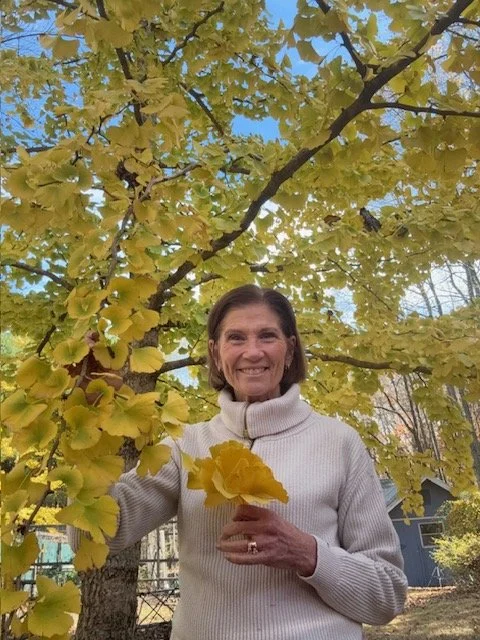
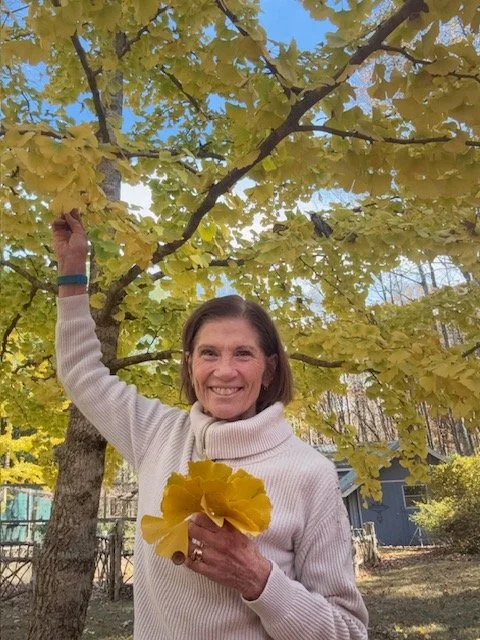
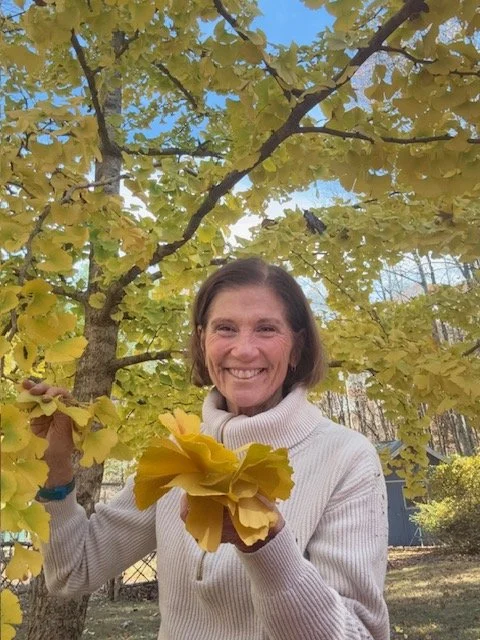
It’s one of my favorite days of the year. The ginkgo leaves started falling at our house! I couldn’t resist going outside to gather a handful of those golden fans and dance in the shower of gold. I can’t waste a minute. In two days, that tree will be bare!
As much as I love these trees, their story gets me every time. The ginkgo family was around before the first dinosaurs, and a single tree can live a thousand years. A whole millennium! Yet ginkgos nearly disappeared. A few populations held on in China, where people helped keep them going by planting and tending them. I like to think of that as their first rebirth.
If trees had superheroes, I’d put the ginkgo on the list. It has natural defenses against insects and disease, and it can hold its own beside busy roads, even with exhaust in the air and barely any room for its roots.
Several ginkgos survived the 1945 atomic bombing of Hiroshima. In the aftermath, they put out new green shoots. Imagine what it must have felt like to see that new growth amid so much loss. I can see why these trees became symbols of hope, renewal, and peace.
Maybe it’s because I spend so much time with dental teams, but standing under that tree got me thinking about what helps a practice hold up on a hard day. A little room built into the schedule can mean you get to say, “Yes, we can see you today,” to someone who’s been up all night with a toothache. That’s a well-designed system doing its job. And when you say, “Come on in. We’ll help you figure this out,” the warmth in your voice shows your practice’s culture. You can recognize a ginkgo by a single leaf. Sometimes one visit is enough for a patient to know what makes your practice special.
Someone may come to you hoping to eat comfortably again or to smile in a family photo without thinking twice. Sometimes, before you’ve even touched a tooth, you can give them peace of mind just by listening and helping them see what’s possible.
That’s what I love about my work at Baird Dental Business Concepts. I get to help teams make more room for the moments when a patient thinks, I’m glad I came here. These people are on my side.