Your Work Culture is Your Most Powerful Competitive Advantage
The Conversation Is Changing
For years, the dental industry has framed its workforce challenges as a staffing shortage. Not enough hygienists. Not enough assistants. Not enough qualified people to fill the chairs.
But what if that framing has been wrong all along?
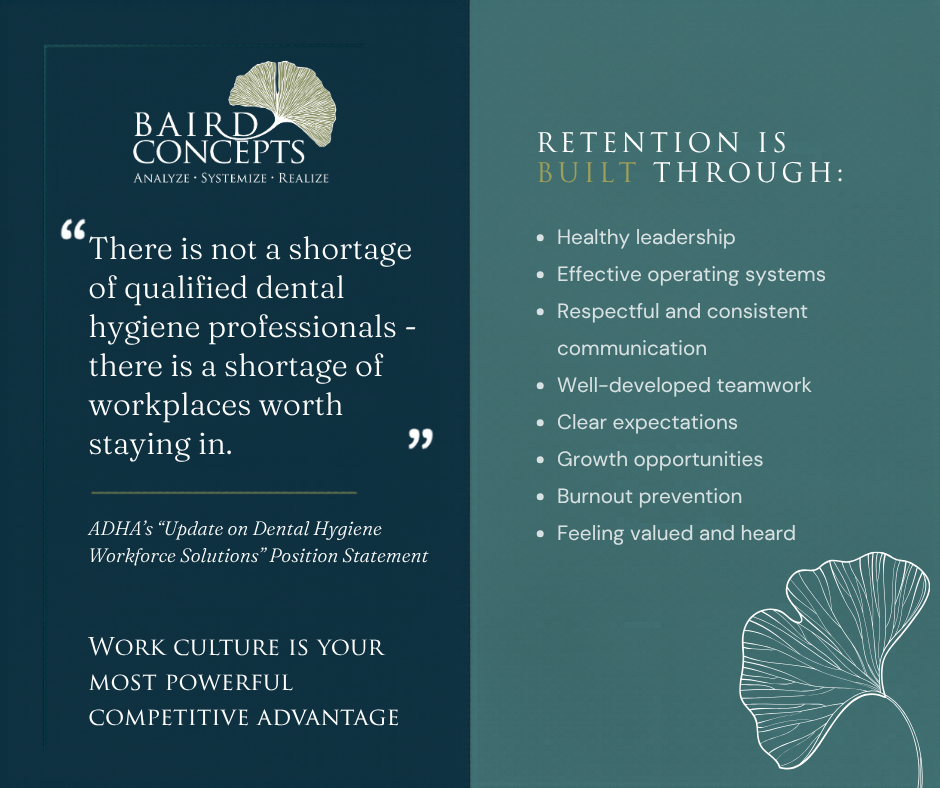
The American Dental Hygienists' Association (ADHA) recently issued an updated position statement that reframes the issue entirely. After reviewing three independent bodies of research, the ADHA reached a pointed conclusion: the profession is not facing a shortage of qualified professionals — it is facing a shortage of workplaces worth staying in.
Read that again.
It is not a pipeline problem. It is a cultural problem.
What I Hear Every Day
In my work as a Practice Management Coach and Consultant, I sit across from dentists, office managers, hygienists, dental assistants, and front desk personnel. I hear their frustrations, their goals, and — increasingly — their reasons for leaving.
And here is what I can tell you with confidence: the ADHA's findings are not a surprise to the people actually working in dental practices.
The reasons employees leave are consistent across every role:
Feeling undervalued or invisible
Toxic or inconsistent leadership
No clear path for growth
Burnout with no relief in sight
Being talked at rather than listened to
A sense that the practice runs on chaos, not systems
This is not a hygiene-specific problem. I hear the same story from front desk personnel, dental assistants, and administrative staff. The role changes. The story does not.
That should make every practice owner stop and think seriously.
Why Salary Alone Is Not the Answer
When retention becomes a problem, the instinct for many dentists is to reach for compensation. Offer more money. Add a bonus. Bump the hourly rate.
Compensation matters. It needs to be fair and competitive. But it is rarely the primary reason a good employee stays — and it is rarely the primary reason they leave.
Research across industries consistently shows that once employees feel adequately compensated, the factors that drive long-term retention are almost entirely cultural. Employees stay where they feel respected, supported, and like their work has meaning beyond a paycheck.
Dental practices are no different.
If your team is walking out the door despite competitive wages, the problem is almost certainly not the number on their paycheck. It is the environment they walk into every single day.
What Retention Actually Looks Like
In high-retention practices — the ones that consistently attract and keep great people — certain things are almost always present:
Healthy leadership. The dentist and office manager model the behavior they expect. They communicate calmly under pressure. They do not create a culture of fear or favoritism.
Effective operating systems. The practice runs on clear, documented workflows. Employees know what is expected, how to do their job, and where to go when something goes wrong. Chaos is the enemy of retention.
Respectful and consistent communication. Team meetings happen. Concerns are heard. Feedback flows in both directions — not just top-down. Employees are not blindsided by decisions that affect them.
Well-developed teamwork. High-retention practices invest in team cohesion. People know their role, trust each other's competence, and work toward shared goals.
Clear expectations. Ambiguity breeds anxiety. When employees know exactly what success looks like in their role, they can achieve it — and feel confident when they do.
Growth opportunities. People need somewhere to go. Whether that is expanded clinical skills, a path to leadership, or simply an investment in continuing education, employees who feel stagnant leave.
Burnout prevention. Dental work is physically and emotionally demanding. Practices that ignore this pay for it in turnover. Manageable schedules, team coverage, and genuine check-ins go a long way.
Feeling valued and heard. This is perhaps the most fundamental. Employees who feel seen and appreciated do not need to be chased with counteroffers. They already know they are in the right place.
The Practices That Will Win
Today's dental employees want more than a paycheck. They want workplaces where they can grow professionally while maintaining their well-being, a balanced lifestyle, and a genuine sense of belonging.
This is not a generational trend that will pass. It is a permanent shift in workforce expectations — one that the data, the research, and the lived experience of dental employees have confirmed over and again.
The practices that understand this shift will be the ones that retain exceptional people, build cohesive teams, and rise well above the average dental practice in every measurable way — patient experience, productivity, profitability, and reputation.
Work culture is no longer a soft, secondary concern. It is not something you address after the scheduling system is fixed or the new equipment is installed.
Work culture IS your operations. And it is your most powerful competitive advantage.
Where to Start
If you are reading this and recognizing your own practice, the good news is that culture is not fixed. It can be assessed, rebuilt, and sustained — with the right systems and the right support.
If you are not sure where to begin, start with one honest question: Would you want to work here?
That answer will tell you everything.
Sandy Baird, MBA, is a Practice Management Coach and Consultant and the founder of Baird Dental Business Concepts. She works with dental practices to analyze workflow, build effective operating systems, and develop the leadership and culture that retain great teams.
Ready to take a closer look at your practice culture? Contact Sandy for a complimentary consultation.
📌 Source: American Dental Hygienists' Association. Update on Dental Hygiene Workforce Solutions. Updated Position Statement, May 1, 2026.