Dental Practice Management

Talking to your team all day isn't the same as communicating as a team. New research from Harvard Business Review Analytic Services shows what regular, structured meetings actually build: stronger relationships, better culture, and higher engagement — the exact things dental practices are trying to solve with everything except a meeting.
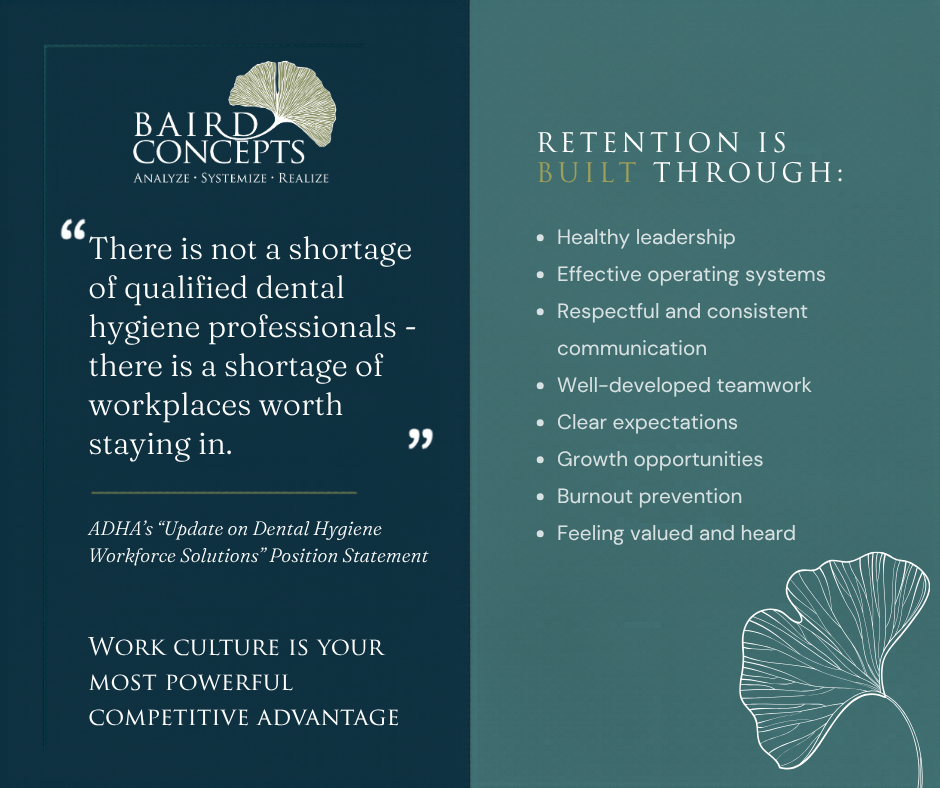
The American Dental Hygienists' Association has reframed the dental hygiene workforce crisis: it's not a shortage of qualified professionals — it's a shortage of workplaces worth staying in. As a Practice Management Consultant, I hear the same from every role in the dental office. Salary alone doesn't retain great people. Work culture does. The practices that understand this will be the ones that thrive.

Are you more than a can of green beans on the shelf? To patients, dentists often look interchangeable—same license, same procedures, same technology. Sandy Baird, MBA, argues your one unbuyable advantage is culture. Leadership behavior, communication training, team commitments, and performance systems shape a healthy culture that boosts loyalty, productivity, referrals, reviews, and employee retention.

Having worked in dentistry for over 40 years, Sandy Baird, MBA, is always interested in knowing dentists’ biggest pain points. Learn how you compare to your peers in the results of her latest dental benchmark survey.

According to a recent Gallup Workplace survey, 51% of US employees are actively seeking a new job. This statistic is especially worrisome in the dental industry due to an existing shortage of dental personnel. Learn the primary reasons dental employees depart and ways you can prevent it from happening.

As with the human body, monitoring and benchmarking your dental practice's vital signs can alert you to weakened operating systems, work culture dysfunctions, threatening trends, and money leaks.

“Doctor, I need to talk with you briefly.” Your stomach drops to your feet. Great, just great. She’s quitting, you think, and that is exactly what she does. She says it is for money, but you know there is more to it. Your brain races. Implement 10 systems to manage your practice and retain your most important asset: your dental employees.

So much of what is happening, or in some cases, not happening in your dental practice is invisible to you as the Dentist, leader, and owner. You are simply too deep in the trees to see the forest. A practice evaluation by an outside practice management business expert can be incredibly valuable to you, your team, and your practice and set your practice on the path to long-term success.

This month, we’re playing baseball, specifically, leadership baseball. You, the dentist, are the owner of this team, which we will call, “Team D” (for dental). You purchased Team D with a boat-load of money, time, and sweat by graduating dental school and purchasing or buying into a dental practice. Those decisions are what launched you into this game of leadership baseball.

“IT’S JUST NOT FAIR!” How often do we hear this phrase from toddlers and elders, alike? In fact, studies suggest humans are born with an innate sense of justice and fairness! So, when something happens that challenges our primal sense of justice, there’s no telling the consequences. We see such consequences play out every day in areas such as healthcare, income, human rights, and even your dental practice.

You can spot disengaged dental employees a mile away. Research giant Gallup has found that globally, 85% of employees are disengaged in the workplace, and they under perform as a result. The dental industry is not immune! Your practice is not immune!

Scheduling is one of the most essential elements of your practice. It is directly tied to your profits, stress level, and patient satisfaction. Yet, I see practice after practice allowing their schedule to reduce their income, create work chaos, and drive patients away.

Want to maximize your retirement savings? Need funds for new equipment, technology, or an office renovation? Want to get those debt burdens off your back? Having a hard time making ends meet?

Professional burnout is an epidemic! In a survey of over 1,000 Human Resource managers, 98% indicated that burnout was actually “sabotaging” their businesses. Many managers indicated that professional burnout accounted for 50% of their employee turnover!

Your Dental Practice Income Statement, sometimes called your Profit and Loss Statement, or your P&L Statement, can be a foundational management tool for your practice if it is purposely designed. Unfortunately, many dentists have no idea their Practice Income Statement can be arranged to meet their specific needs.

When working with practices, often I see significant savings, increased efficiency, and higher patient satisfaction when outsourcing specific tasks and duties. Creating a modern office with progressive technology and effective operating systems makes the difference between a thriving practice and a struggling practice.

“The garbage can or the to-read tub?” This was a regular question I asked my dentist-husband about his proliferating dental journals, articles, and newsletters. Of course, he always had the best intention of reading them all, so 9 out of 10 went to the “TO-READ” PILE. Many times our bedroom was lined layers high with multicolored plastic tubs full of the “to-read” pile. Not to mention the piles at his practice.

It’s Monday morning and your team is gathered for the Morning Huddle. Each goes through their reports and all agree that the schedule looks perfect! There are no openings in the schedule and everyone is ready to roll. But what happens? The infamous NO-SHOW BOMBS start dropping. It hits hygiene first…second…third!!! The final bomb takes out your most productive appointment of the day!

“Sandy, I need help! My front desk person had to leave suddenly due to a personal situation, and may not return. We are all struggling without her! I have deposits hitting my bank and have no idea to whom they belong. I can’t access my own practice’s website, email, or Facebook account. We can’t even attach x-rays to our e-claims! Can you help me?” This type of call happens more often then you would think.

In business school, the mantra they pounded into my head was, “exceed your customers’ (patients’) expectations every single time.” It seems obvious and a no-brainer, but it is much easier said than done. Why? Today’s dental patients are very different from patients even five or ten years ago. There are three core trends that are changing expectations of the dental patient.

Most dental practices know it is critical to have HIPAA dental team training meetings on a yearly basis. Although, many practices don’t talk about it much beyond that. Ongoing reminders throughout the year at team meetings can help keep HIPAA regulations on top of mind for everyone, which can help prevent compliance situations.

Many small business owners, including dentists, make business decisions on instinct. They have so much on their plate they don’t always slow down to document their decisions and processes. This appears to work on a day-by-day basis, but long-term it can cause a multitude of problems. Systemization can release you from management responsibilities and allow you to focus on your patients.
Dental Team Development
Talking to your team all day isn't the same as communicating as a team. New research from Harvard Business Review Analytic Services shows what regular, structured meetings actually build: stronger relationships, better culture, and higher engagement — the exact things dental practices are trying to solve with everything except a meeting.
According to a recent Gallup Workplace survey, 51% of US employees are actively seeking a new job. This statistic is especially worrisome in the dental industry due to an existing shortage of dental personnel. Learn the primary reasons dental employees depart and ways you can prevent it from happening.
“Doctor, I need to talk with you briefly.” Your stomach drops to your feet. Great, just great. She’s quitting, you think, and that is exactly what she does. She says it is for money, but you know there is more to it. Your brain races. Implement 10 systems to manage your practice and retain your most important asset: your dental employees.

In this Dental Leadership Baseball game, the pitchers are your patients and your employees are up to bat. You are the owner and head coach and have assistant coaches on the field and behind the scenes helping you and your team win the league series. Running to first base is when your employees started transforming into team members through the implementation of several leadership tools and best-practices, and patient-oriented operating systems discussed in earlier blogs. Now, second base is looming ahead. The current question is: what leadership skills and tools are needed for your team to arrive safely on second base?

Look, the game is starting! The pitcher is winding up. It’s a classic fastball speeding toward one of your players. Who is the pitcher? It’s Mr. I’m Important, who is one of your patients that is constantly on an impossibly tight schedule. STRIKE 1… STRIKE 2… STRIKE 3… YOU’RE OUT!! What? How could your player be out? You carefully vetted your team players before hiring, you explained to them the ultimate goal of your game, outlined the rules of your game, and supplied your expectations. Where did you do wrong?
This month, we’re playing baseball, specifically, leadership baseball. You, the dentist, are the owner of this team, which we will call, “Team D” (for dental). You purchased Team D with a boat-load of money, time, and sweat by graduating dental school and purchasing or buying into a dental practice. Those decisions are what launched you into this game of leadership baseball.
You can spot disengaged dental employees a mile away. Research giant Gallup has found that globally, 85% of employees are disengaged in the workplace, and they under perform as a result. The dental industry is not immune! Your practice is not immune!
Scheduling is one of the most essential elements of your practice. It is directly tied to your profits, stress level, and patient satisfaction. Yet, I see practice after practice allowing their schedule to reduce their income, create work chaos, and drive patients away.

Having organized and participated in Annual Dental Practice Retreats for over 25 years, I have seen first-hand the many benefits of team retreats. But that is just my perspective, what’s really important is: what does the hard-core evidence say?

Dental team accountability is a topic I frequently address with dentists. In a business like dentistry where the boss must spend 95% of his or her working time in the mouth of another person in order to be successful, accountability becomes even more elusive.

Want a day where you meet your goals, feel a sense of pride in your work, and leave relaxed and on time? Who doesn’t? So, how often does it happen in your dental practice? Once a week? Once a month? Never? There is one way, without a doubt, you can make this happen more frequently and consistently. It is the use of an organized Morning Huddle.

There is a serious conundrum in every dentist’s work life: 99% of your training was clinical dentistry when in reality you spend more than 50% of your time focused on interacting with employees and patients. How do you hear those affirmations from your employees?

First coined by the philosopher Aristotle, the phrase “a whole is greater than a sum of its parts” still has a lot of relevance in this day in age. This is the basis behind the idea of teamwork. If the full dental team isn’t working in synergy your practice isn’t going to be as effective, efficient or run as smoothly as it could, or should, be.

Many practice owners feel like they need to be SUPERDENTIST by day, and the business-minded Clark Kent by night to make sure both of their roles as a dentist and business owner are taken care of. This doesn’t have to be the case. A dental practice that is “organizationally-organized” can alleviate the stress on the practice owner and let them focus on being a dentist.

In my 35 years in dentistry I have heard this phrase over and over again. Most dentists didn’t get into the profession because they wanted to run a business; they did it so they could be DENTISTS! Unfortunately, the business side of running a dental practice often ends up being so overwhelming they aren’t able to enjoy their true passion of dentistry.

Are you looking for ways to increase your dental practice’s annual production? According to a study conducted by Harvard Review, businesses with healthy work cultures produce, on the average, 31% more than those businesses without one. There are three fundamental pieces to ensure a healthy work environment - and bottom line - for your dental practice.
Dental Practice Embezzlement

Dental practice embezzlement is a real issue. It is estimated that between 60% and 80% of dentists will know they were embezzled by the end of their career. Who knows how many never know!

FOCUSED, PERIODIC, COMPREHENSIVE… 0140, 0120, 0150. We are all familiar with these oral exams for our dental patients. We use them daily and know how important they are in detecting and correcting problems and disease in the oral cavity.